
Terminology
This glossary is designed to help you quickly understand the terms used throughout our website. Each definition is written in clear, straightforward language. If you do have any questions about anything listed here, you can always contact us for more information. If there is anything you think that needs to be added or adjusted on this page, let us know by clicking here.
Door Construction & Components
Stile
The vertical frame parts of a frame and panel door, drawer front, or wainscot panel. Stiles appear on the left and right sides of the door, and multi-panel doors may include additional center stiles.
Rail
The horizontal frames parts of a frame and panel door, drawer front, or wainscot panel. Rails are typically located at the top and bottom of the door, with optional center rails in multi-panel designs. Frame and panel doors over 48″ tall are recommended to have a center rail down the middle of the door to help prevent warping at doors of this size.
Panel
- The middle interior component of a frame and panel door, drawer front, or wainscot panel. Panels may be flat, raised, or solid wood.
- A decorative or structural section built like a door but not used as a functioning door (a wall panel or end panel as examples).
Mullion
A vertical or horizontal divider within an open frame door, often used with glass inserts. Mullions create classic grid patterns and help protect the glass. Scherr’s builds both traditional wood mullions and custom MDF mullion grids.
Slab
A door or drawer front made from a single, uninterrupted surface.
- Veneered slab: A stable MDF or plywood core with real wood veneer and matching edge banding. This options is generally recommend for wood slab doors.
- MDF slab: A stable MDF . This options is generally recommend for paint grade slab doors.
- Solid wood slab: Made from glued up hardwood boards. Common for drawer fronts. Less common for doors due to the natural tendency of wide solid wood to cup or warp. Scherr’s can build solid wood slab doors with techniques such as alternating grain direction or adding battens, but some movement over time is expected.
Arch / Cathedral Door Style
The top or bottom rail features an arched profile. Cathedral refers to a more pronounced, pointed arch shape.
Profile
The style of the outside or inside edges of a door, drawer front, frame, or trim piece. Can also refer simply to the shape of a solid wood edge.
Shaker Style
A minimalist, frame and panel door style. The shaker profile emphasized simplicity and durability. These doors feature clean lines, flat panels, and little to no ornamentation. This style pairs well with both traditional and modern interiors.
Joint
A connection between two components usually two pieces of wood. Unlike mechanical joints that allow movement, woodworking joints are designed to be strong and stationary.
Miter
A diagonal or angled cut most commonly at 45° used to join two components together. Mitered joints create cleaner seams and are widely used in door frames and moldings.
Custom Appliance Panel
A door or panel built to attach to compatible appliances such as dishwashers or refrigerators, so they match the surrounding cabinetry.
Cabinet Construction & Structural Elements
Cabinet Sub‑Base
The structural area beneath a cabinet that lifts it slightly off the floor. This prevents water damage, allows room for plumbing, electrical services, and helps with leveling on uneven floors. Cabinets should usually never sit directly on the floor.
Nailer
A 5/8″ thick, 3″ to 4″ wide strip built into the top and bottom of the cabinet back. It provides a strong substrate for attaching cabinets to the studs on the wall. Standard nailers are made from particle board, Baltic Birch or solid wood.
Stretcher
A horizontal divider inside a cabinet that separates the upper drawer area from the lower door area. It acts as a stop and provides a clean visual break between drawers and doors.
Sink Rail
A hardwood rail installed at the top front of a sink base cabinet to maintain structural integrity where a full top panel cannot be used. Sink rails also support false fronts or tip out trays. Some sink bases require both a top and center sink rail, connected by a sink rail spreader.
Adjustable Shelf
A removable shelf supported by clips that fit into pre‑drilled holes. The shelf can be repositioned inside the cabinet.
Fixed Shelf
A permanently installed shelf, often used for appliances where the opening size will not change.
Cabinet Types
Base Cabinet
A cabinet installed directly on the floor. In kitchens, base cabinets support countertops and often form islands or peninsulas. Scherr’s builds base cabinets to a standard depth of 23‑7/8″ and this depth is adjustable.
Upper Cabinet
A cabinet mounted to the wall, typically above base cabinets. Scherr’s builds upper cabinets to a standard depth of 11‑7/8″, and this depth is adjustable. Upper cabinets must be securely attached to wall studs through built‑in nailers.
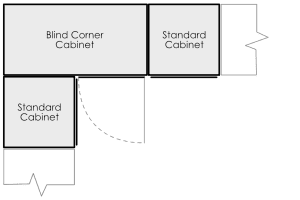
Blind Corner Cabinet
A cabinet installed where two perpendicular cabinet runs meet. Part of the interior extends into the corner, making a portion difficult to see or reach hence “blind.” Optional hardware can improve accessibility.
RTA (Ready to Assemble) Cabinet
Mass produced cabinets sold unassembled and flat‑packed for efficient shipping. Scherr’s cabinets ship unassembled RTA, each cabinet is custom designed, built from premium materials, and crafted using a blend of traditional woodworking and modern technology. Our cabinets are ready to be assembled when they arrive to you.
Face Frame Cabinet
A traditional cabinet construction method where a solid wood frame is attached to the front of the cabinet box. Doors and drawers close against this frame, leaving part of it visible around the openings. Face frame cabinets offer a classic look but reduce interior space and require more complex hardware installation. Scherr’s does not build face frame cabinetry, but can help with refacing existing face frame cabinetry.
Frameless Cabinet
A modern construction method where the cabinet box has no front frame. Doors and drawers mount directly to the cabinet sides, creating a clean, seamless appearance. Frameless cabinets provide larger usable openings, wider and taller drawer boxes, easier hardware installation, and a more contemporary look. Scherr’s builds frameless cabinets.
Drawer Box Elements
Dovetail
A premium joinery method using interlocking trapezoidal cuts that naturally resist pulling apart. Scherr’s drawer boxes use dovetail joinery for exceptional strength.
Roll‑Out Drawer
A shallow internal drawer that slides out from behind a standard cabinet door. Handle pull scoop front cutouts can be included if requested.
Divider
A horizontal divider inside a drawer box that splits the opening front to back.
Partition
A vertical divider inside a cabinet or drawer box that splits the opening left to right. Partitions typically run the full depth of the cabinet or drawer box.
Trim, Moldings & Decorative Elements
Base Molding
Molding installed along the bottom outside edge of cabinets or walls to create a finished look.
Crown Molding
Molding installed at the top of cabinets or where walls meet ceilings. Upper cabinet crown often requires additional support pieces such as crown support and crown fascia.
Light Rail
Molding installed on the underside of upper cabinets to hide under cabinet lighting and create a clean, finished appearance.
Toe Kick / Toe Base / Toe Molding
Material installed at the bottom of cabinets to hide the sub‑base and create a recessed space for your feet. Toe kick molding is typically a simple veneer but can also be decorative when built flush with the cabinet face.
Deco Strip
A versatile hardwood strip, milled to match the thickness and style of your doors and drawer fronts. Used above or below upper cabinets to unify the design. This is a product that IKEA uses, that we can reproduce.
Corbel
A decorative support element placed beneath a countertop or shelf. Corbels visually support the surface above them and add character to this area.
End Panel / Cover Panel
A finished panel applied to the exposed side of a cabinet box, especially at the end of a run or on islands and peninsulas. Panels can be simple slab panels or built to match the door style (wainscot panels).
“L” Filler
A two piece hardwood trim used to make a cabinet appear perfectly flush against a wall. The L‑shaped profile allows easy trimming on site without modifying the cabinet box.
Scribe / Scribe Molding
A thin strip of wood used to cover small gaps between cabinets and walls—especially when walls are uneven. Trimmed on‑site for a tight, seamless fit
Materials
Veneer
A thin layer of real wood applied to the exterior faces of sheet material. Veneer offers the appearance of solid wood with improved stability and lower cost. Veneered materials resist bowing, twisting, and cracking better than solid wood but cannot be sanded as aggressively.
Ply‑Wood
A sheet material with real wood veneer faces over a core made from plywood, MDF, particle board, or hybrid layers. Scherr’s uses only high grade plywood, MDF and melamine materials rated for long term strength and appearance.
Melamine
A durable, easy‑to‑clean surface fused to a particleboard core. Often used for cabinet interiors because it resists moisture, stains, and wear. Scherr’s uses high grade melamine options with white and maple interiors.
Thermofoil
A vinyl material applied over MDF using heat and pressure. Thermofoil doors are smooth, durable, and easy to clean, but cannot be refinished or repaired if the surface is damaged.
Edge Banding
A thin strip of real wood or synthetic material applied to the exposed edges of plywood or MDF to create a finished appearance. Used on slab doors, shelves, and cabinet components.
Hardware & Motion Systems
Soft Close Hardware
Soft close is for hinges and drawer slides that include a built‑in damper that gently pulls the hardware closed during the last few inches of travel.
Hinge Types
- Concealed Hinges: Hidden from view when the door is closed.
- INSERTA Hinges: Allow tool‑free attachment and removal of the door.
Drawer Guide Types (Side Mount, Under Mount)
- Side Mount Slides: Visible on the sides of the drawer box when the drawer is open.
- Under Mount Slides: Hidden beneath the drawer. This is what we usually use, but we do offer side mounted slides as well.
Tip‑Out Drawer
A front panel that tilts outward. This setup is commonly installed in sink cabinets where plumbing prevents a standard drawer. Tip‑out kits are available upon request.
Door Fit & Positioning
Refacing Cabinetry
Updating the visible exterior surface of your current cabinet boxes with all new door fronts, while keeping the original cabinet structure in place. Instead of tearing out and replacing the entire cabinetry, refacing gives the cabinets a new look by replacing the door fronts you currently have. This will give your kitchen a whole new look without the cost involved with replacing all your existing cabinetry.
Reveal
The visible portion of the cabinet box or face frame around the outside edges of the doors and drawer fronts when the doors are closed on the cabinet. Scherr’s frameless cabinets use a 1/16″ reveal on the left and right edges, creating a 1/8″ gap between cabinets.
Overlay
The amount of cabinet frame or cabinet side covered by a door or drawer front. We can help figure door sizes and new hardware if you are looking to reface the cabinetry you currently have for any of the overlay setups below.
- Full Overlay: The door covers nearly the entire frame. Frameless cabinets typically use full overlay with a small reveal.
- Partial/Half Overlay: The door covers only part of the frame. Common in face frame cabinetry.
- Inset (No Overlay): The door sits inside the cabinet frame, flush when closed. Scherr’s does not build inset cabinets but can build doors for inset applications.
Shipping & Fulfillmen
Best Way (Shipping)
A shipping option that allows Scherr’s to choose the safest, most cost effective carrier and method for shipping your order.
FOB (Free on Board – Shipping Point)
Indicates that responsibility transfers to the customer once the shipment leaves Scherr’s facility.